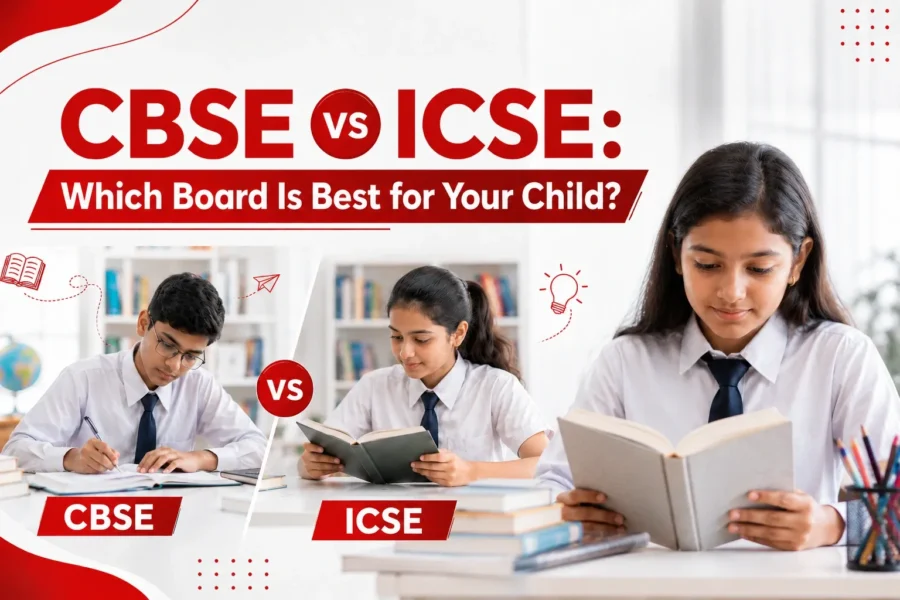
CBSE vs ICSE which is better for child? Every parent asks this question at some point: Should my child study under CBSE or ICSE?
Both boards offer quality education and have produced successful students across every field. But they are built on different philosophies, structured differently, and prepare students for different outcomes. Choosing between them without understanding those differences is a little like choosing between two paths without knowing where either leads.
This guide compares CBSE and ICSE across every parameter that matters to parents — one feature at a time, side by side — so you can make a genuinely informed decision for your child’s future.
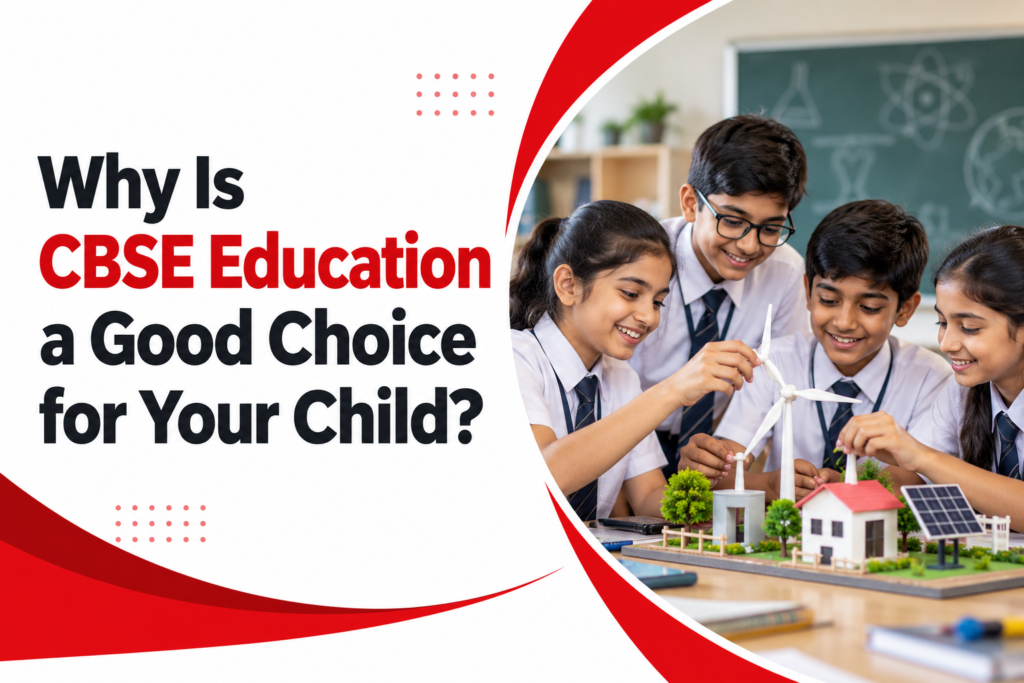
CBSE serves as the national education board for India, administered by the Government of India. It maintains the widest network of affiliated schools nationwide — covering government, Kendriya Vidyalaya, Navodaya Vidyalaya, and private institutions throughout all states and cities. The CBSE syllabus aims to match key national competitive exams such as JEE, NEET, and CUET, rendering it the preferred board for households targeting engineering and medical professions.
ICSE is run by the Council for the Indian School Certificate Examinations (CISCE). It features a wider, more complex syllabus which puts heavy stress on English skills, analysis, projects, and total growth. It holds great respect with global colleges and households looking at foreign schooling.
Choosing between CBSE and ICSE is one of the most important decisions parents make for their child’s academic future, and the right choice depends on more than just reputation. Below is the difference between CBSE and ICSE. We compare both boards feature by feature — covering curriculum, difficulty level, competitive exam preparation, language skills, and more — so you can see exactly how CBSE and ICSE differ before deciding what suits your child best.
CBSE Board: CBSE follows a concise, concept-driven syllabus. Core areas such as Math, Science, Social Science, and English appear within a structured, streamlined layout. The aim rests upon grasping the main notions clearly instead of diving deeply into each topic. This renders it workable for many learners and very useful for competitive test prep.
ICSE Board: ICSE provides a wider and more thorough curriculum. Beyond core areas, pupils examine Literature, Environmental Studies, and Arts as official subjects. The extent of coverage increases, and students must interact with material analytically and descriptively—not merely conceptually.
Verdict: ICSE holds a broader syllabus. CBSE remains more focused. Select according to if your student gains from range or concentration.
CBSE Board: CBSE aims to remain reachable and organized. Material appears plainly clear, queries often stay factual and idea-focused, and learners avoid heavy, long written responses. This creates a superior match for pupils favoring planned, certain evaluations.
ICSE Board: ICSE is often seen as harder. The curriculum has many details, the language need is great, and pupils must write much and think deeply. Projects and internal tests add to the load — yet they make good study ways over years.
Verdict: CBSE demands less intensity. ICSE requires more effort yet constructs firmer bases for analysis and composition skills.
CBSE Board: CBSE holds a distinct and major benefit in this area. Tests such as JEE (Main and Advanced), NEET, CUET, NDA, plus many other national-level entry exams rely on the CBSE curriculum. Learners attending CBSE institutions usually find, these assessments quite known and need fewer extra study materials.
ICSE Board: ICSE pupils possess solid academic foundations and frequently excel in contests yet the curriculum fails to reflect national test formats closely; extra study is usually required to close that divide, especially regarding JEE and NEET.
Verdict: CBSE wins clearly for JEE, NEET, CUET, and all major national competitive exams.
CBSE Board: CBSE offers robust English instruction centered on practical speaking, reading understanding, and basic writing tasks. Learners build firm language abilities, although the priority remains application instead of studying literature deeply.
ICSE Board: ICSE is generally considered better for English learning. Grammar, literature, creative writing, vocabulary, and essay writing are all taught deeply. Students from ICSE backgrounds usually start university with much stronger written communication skills.
Verdict: ICSE generates better English speakers. When language abilities matter much, this counts as a major benefit.
CBSE Board: CBSE evaluations focus mainly on objective and organized formats such as multiple-choice items, brief responses, and issues rooted in concepts. The governing body highlights consistent formative checks throughout the academic period. Such an approach fits learners who excel within standardized examination settings.
ICSE Board: ICSE puts great stress upon project tasks, internal grades, hands-on uses, and lengthy written responses. Learners get checked often regarding how well they can use what they know, rather than just remembering facts. This develops solid thinking and showing abilities gradually through time.
Verdict: CBSE fits those with organized minds well. ICSE works better for learners using practice and artistic showing.
CBSE Board: CBSE institutions operate throughout the whole nation – within major urban centers, smaller tier two and three locations, plus remote villages too. Central government aided schools alongside independent CBSE colleges appear in nearly every specific administrative zone. Households moving around usually discover a CBSE academy close by easily enough.
ICSE Board: ICSE institutions exist in lower quantities and cluster mainly within major metropolises plus big urban hubs. Although ICSE school standards usually remain quite good, access stays much more restricted when contrasted against CBSE options.
Verdict: CBSE gains regarding access. This holds particular weight for households moving because of employment.
CBSE Board: Since CBSE uses a uniform national curriculum, moving between CBSE schools in various cities works smoothly with little trouble. The syllabus stays identical if your child learns in Delhi, Udaipur, Mumbai, or Bengaluru, so there is no break in their study.
ICSE Board: Moving inside the ICSE framework is harder since ICSE schools cluster in big cities. Should a family move to a small town or city, locating a similar ICSE school might fail — occasionally requiring a board change during schooling.
Verdict: CBSE offers much greater flexibility to transferable families. Employees within government, defense, and corporate sectors gain significant advantages.
CBSE Board: CBSE promotes sports, arts, and extra-curricular work with studies — yet numerous CBSE institutions possess robust schemes within these domains. Still, the board’s main focus stays upon academic results and test outputs.
ICSE Board: ICSE focuses upon total growth. Music, arts, drama, games, and creative topics are officially part of studies — not seen as extras. Learners get judged by general progress, not merely test marks.
Verdict: ICSE creates generally better-rounded pupils overall. CBSE institutions possessing robust extra-curricular facilities narrow this divide considerably.
CBSE Board: CBSE holds global recognition and is accepted by universities located in the USA, UK, Canada, Australia, and throughout Europe. Numerous international institutions know the board well and take CBSE certificates without needing extra paperwork.
ICSE Board: ICSE is considered particularly well- conforming to worldwide education benchmarks. The specific syllabus, heavy emphasis on language skills, and practical evaluation methods resemble foreign frameworks such as the UK O-Level. Numerous learners completing ICSE report that moving to distant higher education institutions proceeds quite easily.
Verdict: Both hold international recognition; ICSE might possess a minor advantage regarding direct alignment with global academic styles.
Also Read: Role of Extracurricular Activities in Student Development
Below is a quick CBSE vs ICSE comparison India 2026:
| Parameter | CBSE | ICSE |
|---|---|---|
| Curriculum Scope | Concise and concept-based | Detailed and comprehensive |
| Difficulty Level | Moderate — structured and clear | Higher — deeper and more descriptive |
| Competitive Exam Fit | Excellent (JEE, NEET, CUET, NDA) | Good — needs extra prep for entrance exams |
| English Language Skills | Strong — practical focus | Excellent — literature and writing emphasis |
| Practical Learning | Moderate | High — projects and internals |
| School Availability | Extensive across India | Mostly urban areas |
| Transfer Flexibility | High — easy nationwide transfer | Moderate — fewer schools |
| Holistic Development | Good | Excellent — arts, co-curriculars, projects |
| International Education | Good — globally recognised | Strong alignment with global standards |
| Fees (General Trend) | Often more affordable | Premium schools tend to charge higher |
There is no universal answer — and any guide that gives you one is oversimplifying. The right board depends on your child’s learning style, your family’s circumstances, and your long-term goals.
Choose CBSE if:
Choose ICSE if:
One thing to remember: School quality and teacher caliber often outweigh the board choice significantly. A properly managed CBSE school featuring committed staff, updated facilities, and robust extra-curricular activities frequently surpasses average ICSE schools — and vice versa holds true too.
Should you contemplate CBSE for your offspring and reside near Udaipur, it matters to understand how a balanced CBSE institution functions in reality.
Indo American Public School (IAPS), best CBSE school Udaipur, situated at Golden Arcadia, Balicha, NH-8, Udaipur, provides CBSE schooling from Nursery through Class XII — featuring Science, Commerce, and Humanities tracks at the senior secondary stage. The element distinguishing strong CBSE institutions is not merely the board itself, but rather what surrounds it.
What IAPS Offers Alongside The Cbse Curriculum:
IAPS CBSE school Udaipur, slogan — Ardere the Lucere (Be Enkindled and Enlightened) — shows its dedication to scholarly strictness plus the type of complete growth which parents usually link only to ICSE. IAPS Udaipur admissions for 2026–27 are now available.
Both CBSE and ICSE represent strong options. No single board holds objective superiority — yet one may fit your child’s unique learning approach, your household situation, and future study aims much better.
When competitive tests, moving schools, and fixed study plans matter most — then CBSE stands out clearly. When strong language abilities, full growth, and work projects are valued — ICSE gives a better academic feel.
And whichever board you choose, remember: the school itself — its teachers, its infrastructure, its culture, and its commitment to each student — will shape your child’s education more than any curriculum alone ever can.
ICSE is generally considered more demanding due to its broader syllabus, heavier language requirements, and extensive project and internal assessment workload. CBSE is more streamlined and structured, making it more manageable for most students while still being academically rigorous.
Yes, clearly. The JEE, NEET, and CUET syllabi are closely aligned with the CBSE curriculum. Students from CBSE schools spend their school years studying content that directly overlaps with competitive exam requirements — giving them a measurable advantage. ICSE students often need additional coaching to bridge the gap.
ICSE is widely recognised as superior for English. The board’s curriculum includes formal study of English literature, advanced grammar, creative writing, and essay composition. CBSE’s English programme is strong but more practically oriented.
Yes, transfers between boards are possible, though there can be a period of adjustment given the differences in syllabus, assessment style, and depth of content. For families that anticipate relocation, choosing CBSE from the start is generally more practical.
Yes. CBSE certificates are recognised by universities in the USA, UK, Canada, Australia, and across Europe. Many international institutions are familiar with the board’s standards and accept CBSE students without additional bridging requirements.
Copyright © 2013- 26 IAPS Udaipur. All Rights Reserved.