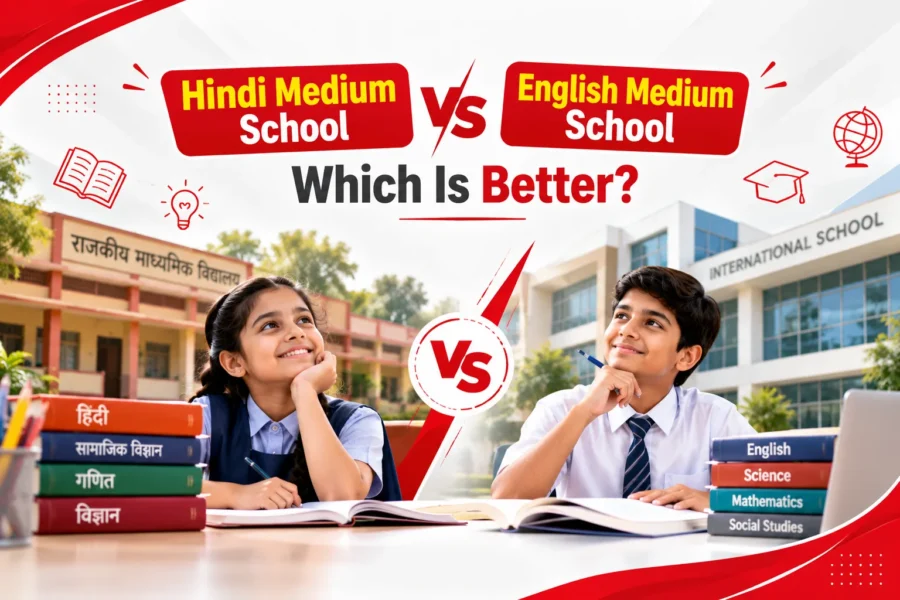
English and Hindi are both languages that are used as the medium for studying other subjects. To choose the right school medium is a tough decision and must be calculated from all aspects. This is because you want your child to understand lessons now and build skills for later. So, is a Hindi medium school or an English medium school the better choice?
It depends on the language your child understands well and has been speaking since childhood, the quality of teaching at the school and the support each school offers. Hindi-medium learning may help children grasp new ideas in a familiar language, while English-medium learning gives them more daily practice with English.
However, as a parent you must know that neither option guarantees better grades or career success. Compare the available schools carefully, not just the language, before you decide what suits your child.
Of course, a Hindi medium school teaches most subjects in Hindi, while an English medium school teaches most subjects in English. However, the language alone cannot tell you how well a school teaches or how much support your child receives.
For example, a child who understands Hindi well may follow new ideas more easily in Hindi. On the other hand, a child who already understands English may feel comfortable learning in English. In either case, check how teachers explain difficult topics, invite questions and help students develop both languages.
English is one of the global languages that the entire world relies on for its English medium education gives your child regular practice with English while they learn other subjects. This can help if they later use English-language textbooks, apply to a course where instructors teach in English or enter a job that needs strong English communication. Still, good teaching and subject knowledge matter in either medium.
In an English medium school, your child reads, writes, listens and speaks English during lessons. As a result, they get regular chances to build vocabulary and learn academic terms. However, exposure alone does not guarantee fluency. Teachers should explain new words and encourage students to speak without fear of mistakes.
Many study guides, websites and learning resources use English. So, students who practise academic English at school may find these materials easier to use later. Even so, check the teaching quality or memorising English words does not replace understanding the subject.
Some college courses, professional resources and jobs require strong English language skills. Therefore, regular practice may help your child feel more confident in those settings. At the same time, English medium schooling does not guarantee admission or career success. Your child also needs subject knowledge and skills that match their goals.
Staying connected to the roots is never a waste. Hindi medium education lets your child learn subjects in Hindi. If Hindi is the language your child understands best, this approach may help them focus on ideas instead of unfamiliar instructions. However, check that the school also gives students chances to develop English as their second language because it is a global language.
Young children often need time to learn a subject and a new language. When teachers explain an idea in familiar Hindi, your child may follow the lesson and ask questions more easily. As a result, they can focus on the topic instead of translating every instruction.
If your child feels confident speaking Hindi, a Hindi medium classroom may help them take part in discussions. Group Activities can also give students opportunities to share ideas, practise communication, and build confidence while learning with their classmates. Still, confidence also depends on the teacher. Look for a school where teachers welcome questions and help students explain their thinking.
Hindi medium education can help your child improve Hindi reading, writing and expression. At the same time, the school can teach English as a subject and give students practice in speaking, listening, reading and writing. Children can build skills in both languages.
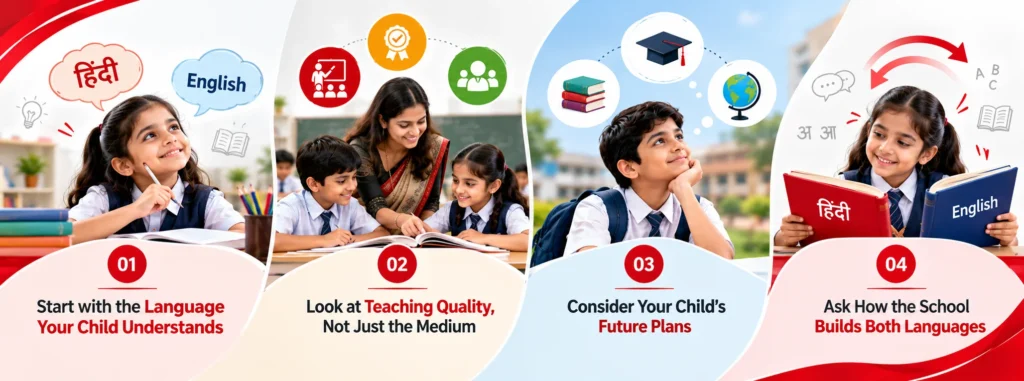
There is no single best medium for every child. Compare your child’s language comfort, the school’s teaching quality, future study plans and language support. When comparing CBSE and RBSE schools, also check the curriculum, subject requirements, teaching approach, and language support offered by each school. Also, consider the school your family can access and afford.
Think about the language your child uses to explain an idea or ask for help. If they understand Hindi much better, ask how a Hindi medium school will support their English development. If they already follow English instructions comfortably, an English medium school may suit them. Either way, choose a setting where your child can understand lessons and speak up.
Visit the school and ask teachers how they explain difficult topics, check progress and help children who fall behind. You can also ask what classroom practices they use to improve a child’s concentration, encourage active learning, and help students stay engaged during lessons. For example, ask what a teacher does when a student can repeat a definition but cannot explain the idea. Their answer can tell you more than a label on the school gate.
If your child has a clear goal, check the language and subject requirements for the courses or exams they may pursue. English can help with English-language resources and some college courses. However, a Hindi medium background does not block your child from higher education or a career. They may need to strengthen English if their next step requires it.
A good choice should not leave your child struggling with the second language. Ask an English medium school how teachers support children who are still learning English. Likewise, ask a Hindi medium school how it teaches English and gives students regular practice. Before you enrol, make sure the school can explain its approach clearly.
Yes. Hindi medium students can succeed in English medium colleges and universities. They may need time to adjust to English lectures, textbooks, assignments and subject-specific terms. With steady practice and the right support, they can build those skills while learning their subjects.
Start with short tasks. Your child can read an age-appropriate English book, summarise a paragraph, learn subject-related words and practise conversations. In addition, educational videos and simple articles can help them connect spoken and written English.
Before your child applies to a college or professional course, review its language, subject and entry requirements. Then practise the reading and writing the course expects. This gives your child time to improve their English before classes begin.
Before you choose a Hindi medium school or an English medium school, ponder a few questions below.
Also, check whether the school’s promises match what you see during a visit. Compare your options and give your child a chance to share how they feel about the classroom language.